2026-09-16 · Dave Kessler
When to Retest After Radon System Installation
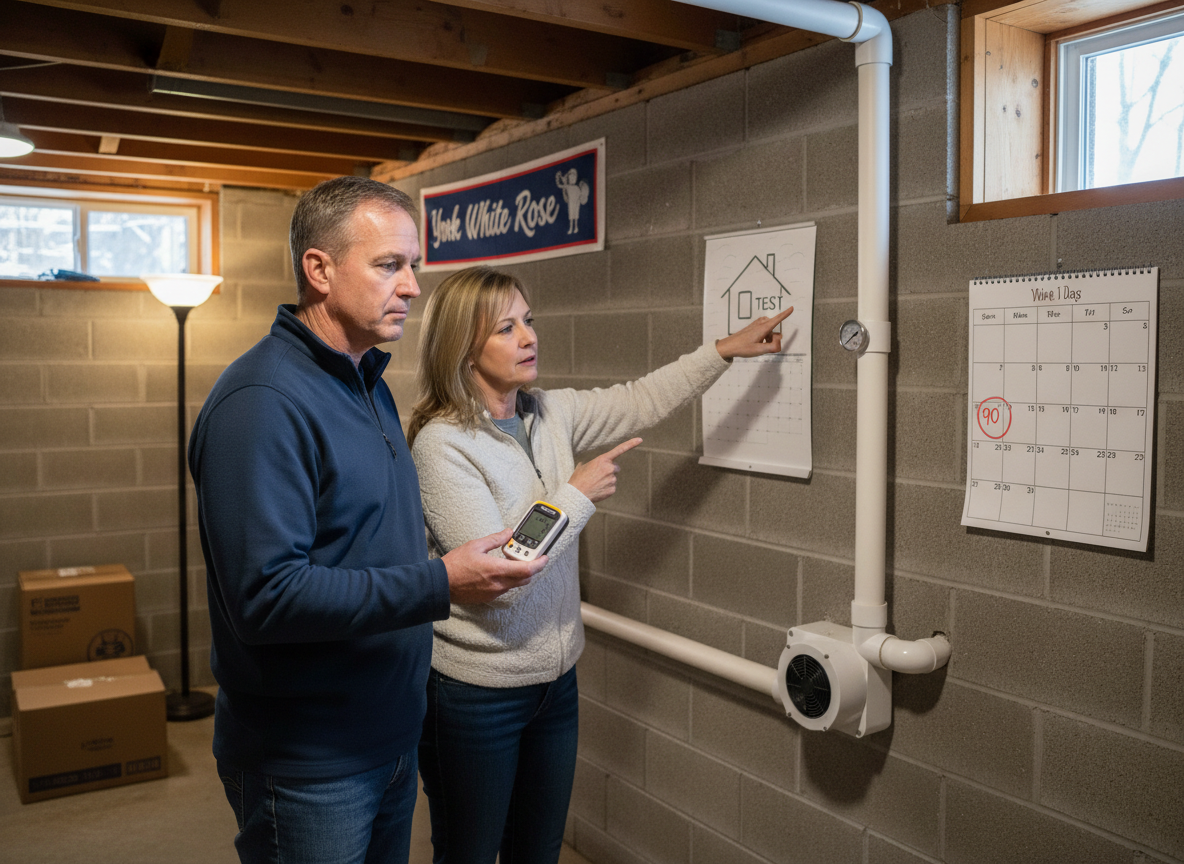
The right window to retest after a radon mitigation installation is 24 to 48 hours after the system is running, using a short-term test placed in the same spot as your original test. This confirms the fan and piping are pulling radon from beneath the slab correctly before we call the job done. After that, we recommend another check at the one-year mark, and then every 2 years going forward, since soil conditions and house pressure shift with seasons here in York County.
Why the First Retest Can't Wait
A newly installed sub-slab depressurization system needs to prove itself immediately, not months later. When we finish a sub slab depressurization install in a rowhome in Downtown York or a split-level in Spring Garden Township, the manometer on the pipe tells us there's suction, but it doesn't tell us the actual radon number. Only a test does that. Waiting weeks to retest means you're living with an unknown for no reason — and if the system underperforms, you want to know while the crew and equipment are still fresh in mind, not after drywall dust has settled and life has moved on.
We place the retest kit in the same lowest livable area as the original test — a basement rec room in East York, a finished lower level in Pinehurst — because radon levels vary room to room and floor to floor. Testing in a different spot gives you a different number that isn't comparable to your baseline, which defeats the purpose of confirming the fix worked.
What the Numbers Should Show
A properly functioning system typically drops readings well below the 4.0 pCi/L action level, often into the 0.4–2.0 pCi/L range depending on the house. If your 48-hour retest comes back above 4.0, something's off — a leaky seal around a sump lid, an undersized fan for the square footage, or a slab with more fracturing than expected. This isn't rare in older York homes with rubble foundations or fieldstone basements common in neighborhoods near Central Market House and North York, where soil gas can find more than one path in. When results run high, we look at radon system repair options before assuming the whole install needs redoing.
- Below 4.0 pCi/L: system is working, move to annual and then biennial retests
- 4.0–8.0 pCi/L: often a sealing or fan-capacity issue, not a full redesign
- Above 8.0 pCi/L: warrants a return visit to inspect suction points and pipe routing
The One-Year Retest and Why It Matters
Radon mitigation systems don't fail often, but fans do wear, and York's swing from humid, hot summers to cold winters puts real stress on outdoor-mounted fan housings and PVC joints. A one-year retest catches slow drift before it becomes a problem — a fan running quieter than it used to, a slight vacuum loss, a joint that's loosened from thermal cycling. We've seen this most in homes near the York Fairgrounds and out toward Codorus State Park, where exposed exterior fan runs take more weather. Catching a small issue at 12 months is a $150–$300 fix; catching it at 5 years after it's been silently underperforming means more air quality risk in the meantime.
This is also a good checkpoint to glance at your test placement and make sure nothing's changed structurally — a finished basement addition, a new sump pump, or a crawl space conversion can all shift how radon moves through the house even with the same mitigation system in place.
Long-Term Retesting Schedule
After the one-year mark, retesting every 2 years is the standard we recommend for most York County homes, whether you're in a brick colonial near the Strand-Capitol Performing Arts Center or a newer build out toward West York. Homes with active systems rarely need more frequent testing unless something changes structurally — a renovation, a new HVAC system, or storm damage to the exterior fan unit. If you're ever unsure whether a reading reflects a real problem or normal short-term fluctuation, a post mitigation test run over a longer period (like a 90-day kit) gives a more stable picture than a quick 48-hour snapshot.