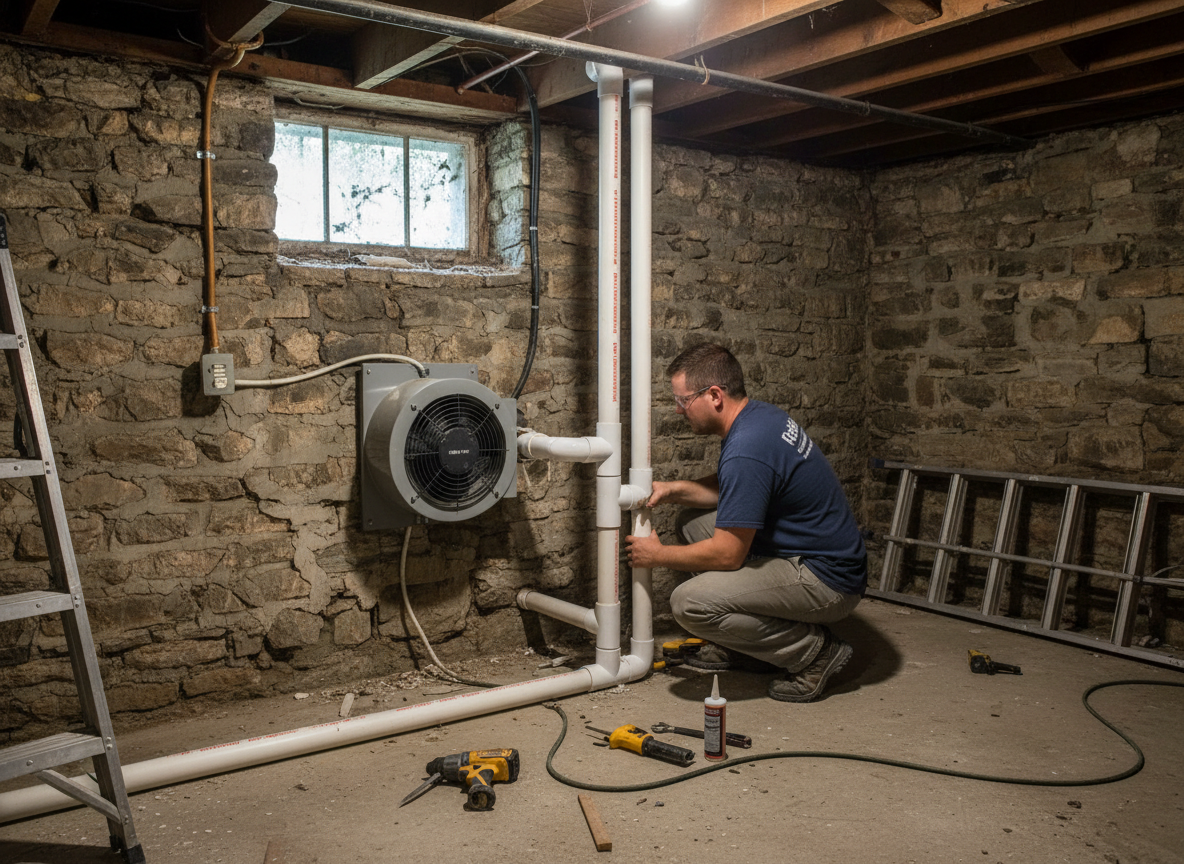
Most of the repair calls we get in York don't come from brand-new systems — they come from systems installed years ago in the older housing stock around Downtown York, West York, and North York, where basements and crawlspaces were finished or altered after the original mitigation work went in. A finished basement wall built over a suction pipe, a dropped ceiling hiding a joint, or a homeowner who unknowingly disconnected a fan during a renovation are the most common reasons systems stop working here. We also see a lot of failed U-tube manometers that nobody ever checks after year one, so the system has been silently dead for months before anyone notices.
York's humid continental climate is hard on exterior-mounted fans. Summers push moisture and heat into the fan housing, and winters bring freeze-thaw cycles that crack PVC joints and loosen roof or wall penetrations, especially on homes in Spring Garden Township and around Devers and Pinehurst where older exterior fan mounts weren't sealed with UV-stable sealant. A fan that's been running continuously for several years in this climate is a wear item, not a lifetime part — when one fails, we replace it rather than patching it, because a patched fan motor in this weather will just fail again within a season.
Soil conditions matter too. York County sits on a mix of limestone and shale bedrock with plenty of clay soil, which means suction pipes routed through crawlspaces near Codorus State Park or the rockier lots on the east side of town sometimes pull in more moisture than a system was designed for, leading to water pooling in low points of the pipe run and reducing airflow. That's a repair issue disguised as a fan issue — swapping the fan won't fix it if the real problem is a low spot in the pipe collecting condensation. We check pipe slope and drainage before assuming it's electrical.
Not every alarm or high reading means the whole system is bad. Sometimes it's a loose electrical connection at the fan, a disconnected manometer tube, or a sealant failure around a sump lid or slab penetration that's letting radon bypass the system entirely. We diagnose before we quote — replacing a fan on a system with a sealing failure just wastes money and leaves the real problem unresolved.
Technician insight
In York, the thing that catches most people out with radon system repair is assuming a low reading on the manometer means the fan is dead, when half the time it's a finished basement wall from a remodel that's crushed or hidden the pipe run. I always ask when the basement was last worked on before I touch the fan, because in West York and Downtown York especially, that's usually the real story.
Hidden Pipe Behind a Finished Wall in West York
A homeowner near West York noticed the manometer reading had flatlined and assumed the fan had burned out. On inspection the fan was running fine, but a basement remodel two years earlier had boxed in the suction pipe behind a new stud wall without anyone checking the run first. We opened a small access panel, confirmed the pipe was intact but disconnected at one joint from the wall framing pressing on it, resealed the joint, and retested — airflow and readings returned to normal the same day.
Radon System Repair Services We Offer
✓Radon Fan Replacement
Swap out failed or underpowered exterior/interior fans, common after several winters of freeze-thaw stress on housing in Spring Garden Township and North York.
✓Cracked Pipe & Joint Repair
Repair PVC piping cracked by UV exposure, foundation settling, or freeze cycles common in older York County basements.
✓System Reactivation After Renovation
Reconnect or reroute mitigation piping disturbed during basement finishing or remodeling work, a frequent issue in Downtown York and West York homes.
✓Manometer & Alarm Repair
Fix or replace failed U-tube manometers and electronic alarms so you actually know if the system stops working.
✓Sealing Repairs
Reseal sump lids, slab penetrations, and pipe entry points where the original seal has degraded, letting soil gas bypass the system.
✓Low-Flow Diagnosis & Pipe Rerouting
Identify and correct pipe runs collecting condensation or clay soil moisture, common on crawlspace systems near Codorus State Park.
Radon System Repair Cost in York, PA
| Service | Typical Range | What Affects It |
|---|---|---|
| Diagnostic Visit | $75–$150 | Often credited toward the repair if you move forward |
| Fan Replacement | $250–$500 | Depends on fan size and mounting location (roof vs. exterior wall) |
| Pipe or Joint Repair | $100–$300 | Number of joints, accessibility, whether finished walls need opening |
| Manometer/Alarm Repair or Replacement | $50–$150 | Simple swap vs. rewiring an electronic alarm |
| Sealing Repair (sump lid, penetrations) | $100–$350 | Depends on number of penetrations and sealant condition |
| Pipe Rerouting for Drainage Issues | $300–$700 | Crawlspace access and pipe run length drive the cost |
Ranges are typical for York, PA and confirmed with an exact written quote before any work starts.
How it works
- 1
Diagnostic Visit
We test system airflow, check the manometer, inspect visible piping, and test at the fan itself to isolate whether the problem is mechanical, electrical, or a sealing failure.
- 2
Retest Radon Levels
We run a short-term radon test to confirm whether the system is actually underperforming or if the alarm/manometer was giving a false signal.
- 3
Repair Plan & Quote
You get a straight answer on what's actually broken, an upfront price, and options if more than one thing needs fixing.
- 4
Repair Work
Fan swap, pipe repair, resealing, or rerouting — done in one visit in most cases.
- 5
Confirmation Test
We verify system draw and airflow after the repair so you're not left guessing whether it worked.
Pricing
Most repairs run less than a full new system install — typical jobs are diagnosed and fixed in a single visit, priced upfront before work starts.