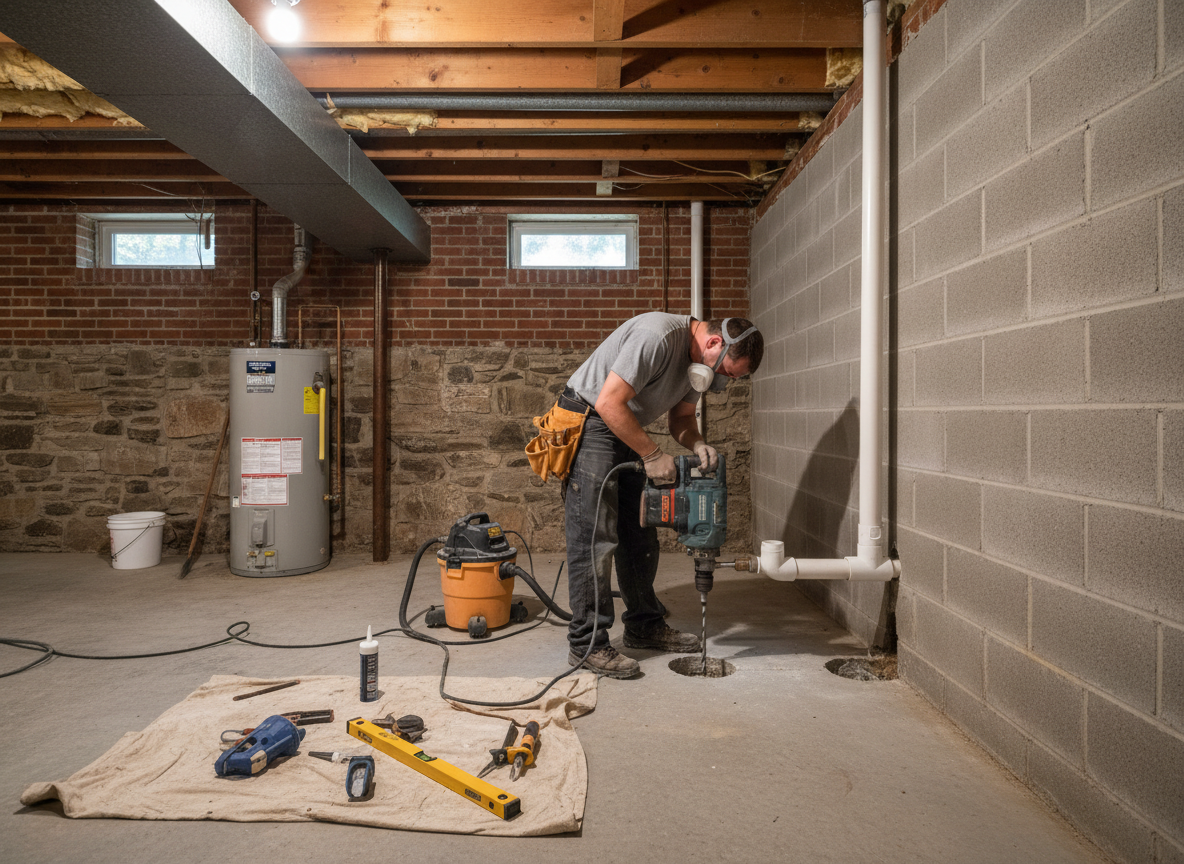
York County sits on a mix of limestone, diabase, and fieldstone geology, and it shows in the housing stock — from the rowhomes near Downtown York and Central Market House to the older farmhouses scattered around Spring Garden Township and Devers. A lot of these homes have fieldstone or rubble foundations rather than clean poured concrete, which changes how a mitigation system has to be designed. You can't just seal a slab and drill one hole; you're often dealing with dirt floors in sections of the basement, multiple foundation pours from additions over the decades, and gaps between stone that need to be sealed with polyurethane sealant before a sub-slab depressurization system will pull a consistent vacuum.
In neighborhoods like West York and East York, where houses were built in waves from the early 1900s through the 1950s, I regularly find sump pits that were never sealed, old coal chutes that got bricked over but not air-sealed, and cracked clay tile drains running under the slab. Each of these is a short-circuit point that will wreck your suction field if it's not addressed during installation. Homes near North York and Pinehurst with crawlspaces need a different approach entirely — usually a vapor barrier system with its own fan rather than a slab penetration, since there's no slab to draw from.
Cold winters in York mean the fan and PVC piping have to be routed and insulated with freeze risk in mind — I've replaced more than a few fan housings that cracked because a previous installer ran exterior piping without insulation or ran it up the wrong side of the house where wind-driven cold hits hardest. Pennsylvania doesn't have a statewide radon mitigation licensing law tied to municipal permits in every jurisdiction, but York County code officials do expect the discharge point to terminate above the roofline, away from windows and eaves, which is a common point of failure I find on inspection of other companies' work.
Humid summers add another wrinkle: high indoor humidity can make radon readings swing seasonally, so a system sized only off a winter test can be undersized once summer humidity and closed-up air conditioning season sets in. I always design for the worse of the two conditions, not just whatever the initial test showed.
Technician insight
In York, the thing that catches most people out is assuming a sub-slab system will work the same way it does on a clean poured slab in Harrisburg or Lancaster — a lot of our older homes near Downtown York and Devers have fieldstone foundations with dirt sections, and if you don't seal every gap before installing the fan, you'll never build enough vacuum to pull radon evenly. I've also seen homeowners test only in winter and get a false sense of security, when summer humidity and closed-window AC season can push levels right back up.
Rowhome Near Central Market House With Hidden Dirt Floor Section
A homeowner near Central Market House had a radon test come back high despite a fully finished basement. On inspection we found a back corner with an exposed dirt floor behind a stud wall, left over from an old coal storage area, that was letting soil gas bypass the slab entirely. We sealed the dirt section with a vapor barrier tied into the main suction point and re-ran the fan sizing for the added area. Retest came back well below the action level.
Radon Mitigation Installation Services We Offer
✓Sub-Slab Depressurization Systems
The standard fix for basements with poured or partially poured slabs — a sealed suction point and fan draw radon gas from beneath the home before it enters living space.
✓Crawlspace Radon Mitigation
For homes around North York and Pinehurst with crawlspace foundations, using a sealed vapor barrier and dedicated fan system instead of slab penetration.
✓Fieldstone & Rubble Foundation Sealing
Common in older York homes near Downtown York and Devers — sealing gaps between stone and mortar so the mitigation system can hold a consistent vacuum.
✓Sump Pit Radon Sealing
Converting an open sump pit into an airtight radon collection point, a frequent gap we find in unsealed basements throughout West York and East York.
✓Exterior & Attic Fan Routing
Routing PVC piping and fan placement to handle York's cold winters without freeze cracking, terminating discharge properly above the roofline.
✓New Construction Passive Radon Rough-In
Installing passive stub-in piping during construction or major renovation so a fan can be added later without cutting into a finished slab.
✓Multi-Zone System Design
For larger or additioned homes in Spring Garden Township with more than one foundation pour, using multiple suction points tied to one or more fans for even coverage.
Radon Mitigation Installation Cost in York, PA
| Service | Typical Range | What Affects It |
|---|---|---|
| Single-Point Sub-Slab System | $900–$1,600 | Standard basement with one accessible suction point and straightforward pipe run |
| Crawlspace Vapor Barrier System | $1,400–$2,400 | Depends on crawlspace size and access; barrier material and sealing add time |
| Multi-Zone / Multi-Point System | $1,800–$3,200 | Homes with additions or multiple foundation pours need more than one suction point |
| Sump Pit or Foundation Sealing (add-on) | $150–$450 | Number of gaps, pit size, and stone foundation condition affect labor |
| Post-Mitigation Radon Test | $100–$175 | Confirms system is pulling levels below action threshold |
Ranges are typical for York, PA and confirmed with an exact written quote before any work starts.
How it works
- 1
Diagnostic Walkthrough & Soil Gas Check
We inspect the foundation type, check for sump pits, cracks, and additions, and identify how the soil beneath the home behaves — critical in York County's mixed limestone and clay terrain.
- 2
System Design
We size the fan and plan suction point locations based on foundation layout, factoring in York's seasonal humidity swings so the system holds up in both summer and winter.
- 3
Sealing & Suction Point Installation
We seal cracks, sump pits, and stone-foundation gaps, then core the suction point and set the vent pipe.
- 4
Fan Installation & Routing
Fan and PVC piping are installed and routed to exterior or attic space with proper roofline termination and freeze protection.
- 5
Testing & Verification
We run a post-installation radon test to confirm the system is reducing levels and walk you through the manometer gauge so you can monitor it yourself.
Pricing
Most single-suction-point installations in York run in the low-to-mid four figures; multi-zone or crawlspace systems cost more due to extra sealing and piping runs.